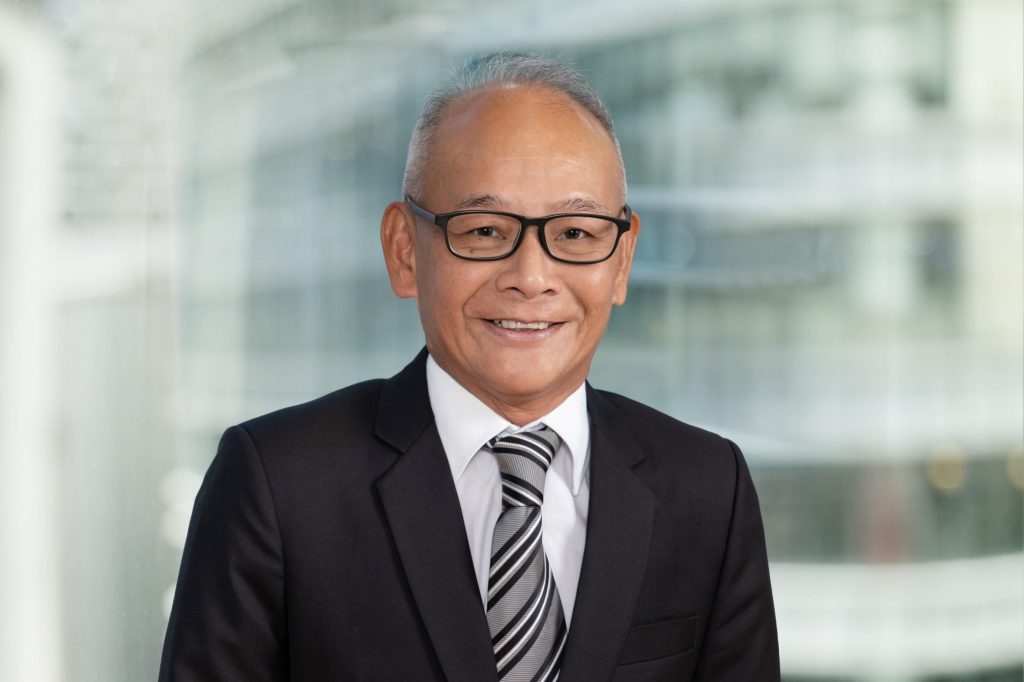
John Seow
- Consultant
- Senior Accredited Specialist, Maritime and Shipping Law
- Fellow, the Chartered Institute of Arbitrators
John is a Consultant in Incisive Law. He has been active in legal practice for more than 30 years, focusing on litigation and arbitration work. He trained as a marine engineer before pursuing a career in law. He was called to the English Bar as a barrister by the Middle Temple in 1995 (non-practising) and to the Singapore Bar in 1996. He spent several years practising in two of the Big Four firms in Singapore prior to joining Incisive Law in September 2023.
John’s engineering background provides him with a distinct competence when dealing with briefs that are highly technical in nature. As such, he has a particular interest and expertise in wet shipping work. Given his background, John is regularly instructed on matters such as collision and salvage, ship repair and construction, engine related claims, marine insurance matters and general average. His clientele includes shipyards, Japanese MNCs, shipowners, charterers, P&I Clubs and H&M insurers as well as some of the world’s leading and preeminent oil & gas and oilfield support service companies.
John also has a vibrant practice in international trade with extensive experience in advisory and advocacy work in commercial litigation and arbitration. In particular, he has advised and appeared as counsel in the sale of goods disputes across international borders covering commodities such as oil, coal, iron ore and grains as well as related trade finance matters. He regularly represents international oil and commodities for traders and trading houses in such disputes.
In addition to his work as counsel, John has been appointed as an arbitrator across a range of institutional and ad hoc arbitration cases.
He has been recognised by Best Lawyers 2022, 2023 and 2024 in Shipping and Maritime Law and Litigation Star in Shipping by Benchmark Litigation Asia Pacific 2026
LLB (Hons), University of London
Member, The Law Society of Singapore
Member, Singapore Academy of Law
Member, Singapore Chamber of Maritime Arbitration
Litigation Star in Shipping – Benchmark Litigation Asia Pacific 2026
Best Lawyers 2022, 2023, 2024 – Shipping and Maritime Law
English
Mandarin (Basic)
- Successfully represented the insurers, led by MS First Capital, in a marine insurance claim brought by the owners/operators and the mortgagees (OCBC) of a liftboat called the TERAS LYZA, which capsized just a few days into her voyage from Vietnam to Taiwan. Following the capsize, the owners/operators decided to scuttle the vessel as they deemed it a constructive total loss (CTL). The owners/operators of the liftboat went into liquidation before the commencement of the trial and OCBC continued alone as claimant as a co-insured. OCBC prevailed in the first instance decision. The insurers appealed to the Court of Appeal who agreed with the insurers that OCBC had not proved that the vessel’s loss was due to an insured peril (namely, perils of the seas) or that the vessel was a CTL and thereby allowed the appeal. (Argoglobal Underwriting Asia Pacific Pte Ltd & others v Oversea-Chinese Banking Corporation Ltd [2026] SGCA 14).
- Represented an oil trader who time chartered an Indonesian-flagged oil tanker for its oil transportation. However, the chartered vessel continuously encountered downtime arising from engine/boilers issues which caused substantial losses/damages to the oil trader arising from the late deliveries of its cargoes to their customers. The oil trader commenced an action against the vessel owners by arresting a sister ship in Singapore (under the terms of the bill of lading issued by the latter under the charterparty) in suit HC/ADM 57/2024. The shipowner and an intervener entered appearances in the suit and applied to set aside the arrest. They asserted that the arrest was wrongly invoked in breach of the High Court (Admiralty Jurisdiction) Act on the ground that the offending vessel was not beneficially owned by the defendant shipowner as she had been sold to the intervener prior to the action being brought. At the first instance hearing of the setting aside application, the oil trader successfully argued that the sale of the vessel by the shipowner to the intervener (who are related companies) was a sham sale or façade with the view to evading liability and therefore the original shipowner retain beneficial ownership in the vessel and the application was accordingly dismissed. This is the first case in Singapore in which the court had ruled that a ship sale was a sham or façade based on the evidence tendered. The shipowner/intervener appealed the decision but before the appeal was heard, parties amicably settled the dispute.
- Successfully represented the appellant in the Court of Appeal in overturning the High Court decision in refusing to enforce an arbitration award which the appellant had successfully obtained against the respondent. The Court of Appeal allowed the appeal and ruled that an arbitral award issued in the name of a dissolved or merged corporate entity could still be enforced by its successor under the doctrine of misnomer. The case also establishes the test for identifying a true misnomer. (National Oilwell Varco Norway AS v Keppel FELS Ltd [2022] SGCA 24)
- Represented the insured in a claim under a valued marine cargo policy in respect of a shipment of steel plates and machinery loaded on a barge towed from Singapore to Sibu, East Malaysia. The shipment was lost in the seas during the voyage. The case defines the scope of the damage to goods attributable to “washing overboard” under the Institute Cargo Clauses in Marine Cargo Insurance. (Hua Seng Sawmill Co Bhd v QBE Insurance (Malaysia) Bhd [2003] SGHC 233)
- Represented the defendant shipowner in a claim brought by the owner of a slop tanker that sank following receipt of chemical slops received from the chemical tanker owned/operated by the defendant. The case centred on whether the defendant shipowner had been negligent when it contracted with the slop tanker owner to receive the chemical slops. The defendant also argued that even if it were liable it was entitled to limit its liability for the loss pursuant to section 136 of the Merchant Shipping Act (giving legislative effect to the Limitation of Owners of Sea-Going Ships 1957 (the “1957 Convention”)). The High Court decided in favour of the plaintiff holding that the owners of a chemical tanker transporting highly dangerous goods owe a direct duty of care to third parties who come into physical contact with the vessel or cargo. The High Court further held that the shipowners were not entitled to limit liability because its management failed to show they had a proper supervisory system ensuring their crew followed international chemical safety protocols (The Sunrise Crane [2003] SGHC 291). The defendant shipowners appealed to the Court of Appeal. In a landmark decision, the Court of Appeal’s corum of 3 Justices of Appeal upheld the lower court decision by a split 2-1 majority decision. The dissenting judge found on the evidence that it was not fair, just or reasonable to expect a shipowner to independently police or double-check whether an independent contractor had lied to or failed to brief its subcontractors. It is also notable from the comments of the dissenting Justice of Appeal that the “protection” available to a shipowner by the 1957 Convention is “largely illusory” subsequently led to the legislative enactment of the Convention on Limitation of Liability for Maritime Claims 1976 (The “Sunrise Crane” [2004] SGCA 42)
- Successfully defended an international MNC oilfield/offshore supply company in an arbitration brought by a local major shipyard/oilrig builder in a claim for alleged defective design/supply of a multimillion-dollar shipboard equipment for an FPSO built by the latter. The case was fought on and won by the defendant on issues which were largely technical in nature.
- Successfully represented a local oilfield/offshore supply company in an arbitration brought against the defendant manufacturer/supplier (of high-performance pipes and fittings for offshore vessels) for repudiatory breach of contract. The respondent’s repudiatory breach had resulted in a claim for damages by the head contractor (which designs, builds, installs and operates offshore floating facilities for the offshore energy industry) against the client which sought to recover these damages from the respondent in the arbitration.
- Successfully defended the respondent, an international oil field services company, in a claim brought by an MNC engineering contractor (who were the main contractor engaged by an oil major to undertake a construction project for its oil refinery in Singapore) in an ad hoc arbitration. The respondent client was sued for damages arising from property damage (caused to surrounding properties owned by the oil refinery) allegedly caused by the “pigging operations” which it had undertaken as part of the construction project as a sub-contractor. The client successfully proved that the property damage was caused by the claimant main contractor’s flawed supervision and/or erroneous instructions during the pigging operations rather than the pigging operations itself.
- Successfully represented the appellant in the Court of Appeal in overturning the High Court decision (the appellant was represented by a different set of lawyers in the High Court) in awarding a multimillion-dollar residential property owned by the appellant company to the respondent on the ground of common intention constructive trust. The Court of Appeal rejected the Respondent’s case that a common intention constructive trust existed on the facts of the case. (Geok Hong Company Pte Ltd v Koh Ai Gek & others [2019] SGCA 150)
- Represented the owners of the vessel “CAPT STEFANOS” in a claim which it brought in the High Court of Singapore by invoking the court’s admiralty jurisdiction by arresting the vessel “REECON WOLF” following a collision between both vessels in the Malacca Straits. The owners of the “REECON WOLF” had earlier commenced an action in the Malaysian admiralty court by arresting the “CAPT STEFANOS” in Malaysia. The matter before the Singapore court concerned the appropriate jurisdiction in which to adjudicate the claims arising from the said collision which gave rise to a complex cross-jurisdictional race. (The “Reecon Wolf” [2012] SGHC 22)
- Successfully represented the shipper/owner of an oil cargo against the vessel owner for cargo contamination. A key preliminary issue was whether the shipper/owner of the cargo had title to sue at the time the Writ was issued. Although an indorsee of the bill of lading, it was not in possession of the bill of lading at the time the Writ was issued. However, the High Court accepted that there was a ship’s delivery order which conferred on the shipper/owner the right to sue in contract pursuant to section 2(1)(c) of the Bills of Lading Act. (The “Shravan” [1999] SGHC 169)
- Acted for the owner of a vessel (and its P&I Club) which grounded at a remote island in the Banda Seas off Indonesia enroute from Australia to Thailand. Attended onboard the stranded vessel onsite to record evidence and investigate into the cause of the grounding with the view of advising on recovery action against potential cargo claims and GA issues arising from the grounding incident.